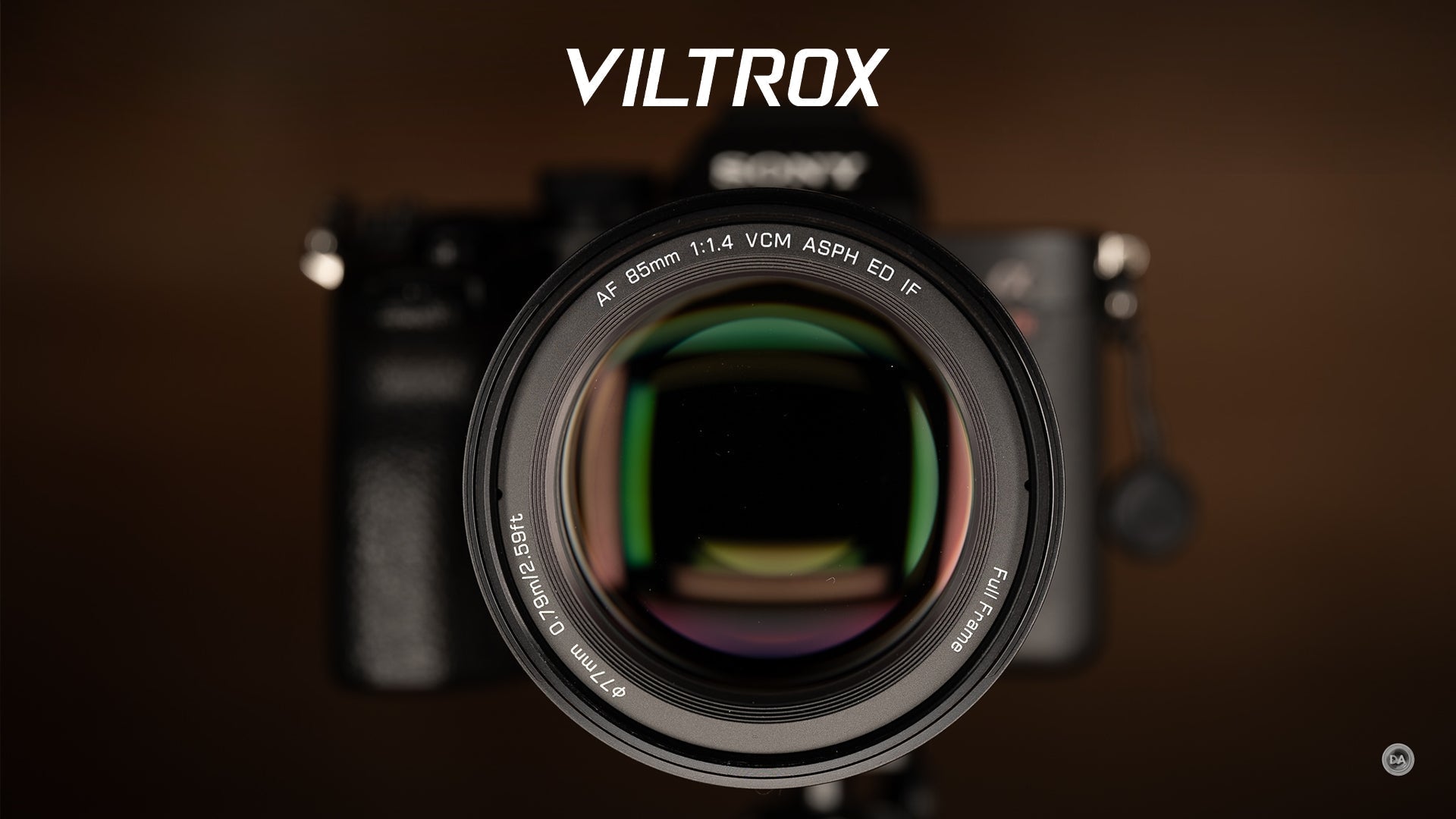
Viltrox AF 85mm F1.4 Pro FE Review
by Dustin Abbott
Meet the Viltrox AF 85mm F1.4 Pro FE
85mm lenses tend to be the top choice of many portrait photographers for a reason. I personally find images from a 135mm lens slightly more exotic, but the focal length is often too long for a lot of environments. An 85mm lens allows you great subject separation but isn’t so long that you can’t use it in an ordinary room. It still works great for outdoor, environmental portraiture, too.

Reprinted from(https://youtu.be/pD52SVOQmiA?si=nus1P7aYdL70EDXR)
We see the Pro formula brought forward to this full frame series, though with a few of the most recent Viltrox tweaks. The 27mm and 75mm Pro lenses for APS-C relied on STM focus motor technology, but the Pro 85mm will use their new VCM (voice coil motor) technology for more thrust and smoother focus action. We’ve got a full set of features, including an aperture ring that be clicked or declicked, a custom/function button, an AF | MF switch, weather sealing, and a USB-C port for easy firmware updates. This is a lens with a GM level of build and features.

On paper everything looks great…but does the Pro 85mm deliver the goods in the real world?

Let’s explore the details…
Viltrox 85mm Pro Build and Handling
The first thing to note is that this is definitely a pro-level build quality, which is interesting considering that this is not their most premium lineup. The more I use the 85mm Pro, the more I appreciate it. It has a clean, streamlined design that is really growing on me.
There are things that I love about Viltrox’s design philosophy on the LAB series, but their integration with the aperture ring is not one of them. The Pro series takes a more traditional approach to controlling aperture, and in this case you can call me a traditionalist!

The aperture ring works perfectly here, with markings at the one third stop positions and light detents at those places if you have the “clicks” on. You also have a declick option where you can smoothly rack from F1.4 to F16. There is a firmer detent between F16 and the A (automatic) option which will allow aperture to be controlled from within the camera. The one aperture feature that is missing is an iris lock which would allow you to either lock into or out of the aperture ring.

I was able to perform aperture racks in the declicked mode without visible steps.
The iris itself has 11 aperture blades, and these make for a nicely rounded aperture even when stopped down a fair bit. Here’s F2, F2.8, and F4.


Sigma dramatically shrunk their newer mirrorless 85mm design as compared to the original 85mm F1.4 ART from DSLR days, and that was one of the most compelling reasons for me to buy it. Viltrox hasn’t quite achieved the same result here, as while this is a moderately sized 85mm lens, it is still fairly large. The Sigma is 82.8mm in diameter and just 96.1mm in length, but the Viltrox is 84.5mm (3.3”) in diameter while being a much longer 108.5mm (4.27”). The effect of being 12mm longer gives the impression that the Viltrox lens is narrower, but, as we’ve seen, that’s not actually the case.

Both lenses sport a 77mm front filter thread.

As one might expect, the Viltrox is the heavier of the two lenses, weighing in at 800g (28oz) compared to the 625g of the Sigma. The new Sony 85mm F1.4 GM II is nearly identical in size but weighs less at 642g.
Viltrox has proven that they can make very competent small lenses in their AIR series, but thus far the Pro and LAB lenses have all been quite large.
The body of the Pro 85mm is very robust, utilizing an aviation-grade magnesium-aluminum alloy blend. This is similar to the materials used in camera bodies and ensures that the lens will be tough and durable for years of use. It has a black anodized finish that looks classic and and elegant. The lens is understated but attractive, with no loud accent colors or attempts to demand your attention.

I do kind of miss the LCD screen from the LAB series as central visual element, but I’m glad that the aperture control is more traditional.
Like the LAB lenses, the Pro 85mm sports floating elements in its design. This has a very positive benefit that we’ll detail momentarily, but those unfamiliar with this design element may be thrown by the fact that something seems to move (and clunk) a bit inside the lens when you tip it up and down. Floating element groups do in fact move forward and backward when the lens is powered off, though as soon as the lens is powered on, those elements are energized and no longer move. You can then tip the lens up and down and nothing happens.
The primary reason for employing floating elements is that it allows the lens to function better at close focus distances. The Pro 85mm can focus as closely as 79cm and produces a reasonably high 0.13x magnification. This bests the Sigma (85cm and 0.12x) and the GM II (80cm and 0.11x). The fact that the Sony focuses closer than the Sigma but produces lower magnification is evidence of some focus breathing, and the floating elements on the Viltrox helps alleviate that focus breathing and produce a higher level of magnification, which looks like this:

Despite the mild disparity in stated magnification figures, I don’t actually see any difference between the Viltrox and the Sigma in actual magnification.

Other features on the lens include a custom/function button and an AF | MF switch. This feature set is similar to the Sigma and Sony save the iris lock button.

What’s interesting is that this will technically be the Viltrox mid-level option, as there will be an even more feature rich 85mm F1.2 LAB coming.
Part of the Pro design philosophy is the inclusion of thorough weather sealing. This includes a HD Nano coating on the front element that resists fingerprints and moisture.

This includes a bright red/orange gasket at the lens mount (which I think is very stylish), internal seals at the switches, rings, and near the front element, as you can see in this diagram.

I count ten seal points in addition to the coating on the front element. I always love when companies are confident enough in their weather sealing to share the cutout of the internal design. Very nice.

The manual focus ring is wide, very nicely damped, and provides a great manual focus experience, with good precision, no lag in the focus (as sometimes experienced on mirrorless lenses with their focus-by-wire systems), and a nice amount of focus throw.

Viltrox continues with a trend that other lens makers are now imitating by including a USB-C port in the lens mount that allows you to do firmware updates right to the lens. I’m a fan of this approach, as it eliminates the need for a separate dock or lens station for firmware updates, and I find the process a little more intuitive than even doing firmware updates through the camera. Even better, however, Viltrox now has an app for iOS or Android where firmware updates can be done either through the Bluetooth module in the lens or by connecting a USB-C cord to the lens and connect it to your phone for a quick, stable process.
There is no lens based stabilization, so you will need to rely upon the in-camera stabilization if your camera is so equipped.

Viltrox has redesigned their bigger front lens caps with a bevel along the front that makes it feel slimmer. The lens also comes with the hood and a leather pouch (similar to Canon L-series lenses). There is some cushion on the bottom, but I don’t find these pouches nearly as useful as a good padded nylon case like what Sigma provides. The lens hood itself is fine, with a gripped section for removing it similar to what Sigma provides, but without the rubberized edge seen sometimes on nicer lens hoods.
The lens hood doesn’t have a lock, but does have a firm bayonet into place that sits securely. I had no issues with it coming loose. It will reverse and fit closely for storage, which is something I have a bit of an issue with on the Sigma lens hood, which flares fairly widely and thus takes up more room for storage.

The Viltrox Pro AF 85mm F1.4 is a beautifully made lens that does weigh a bit more than its primary competitors but compensates nicely by undercutting them in price anywhere from $500 to $1000 while providing a build quality and handling experience that equals those competitors. I am once again very impressed by how Viltrox is able to make beautifully crafted lenses and sell them so much cheaper than competing brands.
Autofocus for Stills
One area where the newer Viltrox lens has an advantage over the older Sigma lens is when it comes to autofocus technology. Sigma was still in their STM era of focus motors (as Viltrox was until recently), whereas Viltrox has now moved to higher end HyperVCM (voice-coil motor) focus in their recent premium lenses. Thus far they seem to be reserving their multiple-motor “hyper-VCM” focus systems to the LAB lenses, but even the single HyperVCM motor powering focus is nice and snappy in the Pro 85mm. I was particularly impressed in the circumstance of this particular shot, as I was out in the pre dawn light in Myrtle Beach, South Carolina and decided to shoot this narrow stalk of dried grasses in the dunes. Focus instantly snapped into the right zone and delivered a shot with perfect precision.

What’s more, focus is perfectly silent, without any accompanying noise or drama. I can put the lens right next to my ear and focus and not hear anything.
The Sony 85mm F1.4 GM II is going to win the focus battle, as it is powered by two of Sony’s high thrust XD linear motors, but the Viltrox is going to stand its ground against most other competing lenses. I suspect the LAB lens will be powered by quad VCM motors and will challenge the Sony for focus speed.
On the Pro 85mm, focus changes are not quite instantaneous, but there is only a split second lag, and focus not only moves quickly but arrives with great confidence. It’s a hair quicker to focus than the Sigma 85mm F1.4 DN and its STM focus motor. With the Viltrox, I can focus on a distant subject and then back to a human subject just a meter away and focus is nearly instantly locked on the eye. That eye is accurately in focus, even in profile.


It wasn’t all that long ago that premium lenses like the Canon EF 85mm F1.2L II would seemingly take minutes to make major focus changes, so it’s pretty impressive at how good focus speed is on a lens like this.
I had no problem nabbing seabirds on the wing at the beach, with quick acquisition and accurate focus.

If we zoom in, we will find that focus is perfect even at F1.4:

Thus slower subjects like humans for portrait work were pretty simple, and the Pro 85mm delivered consistently well focused results in my portraits.


This was true even shooting in a very strongly backlit setting.


There isn’t really much to complain about here. Viltrox has levelled up their autofocus systems in their premium lenses, and the end result is improved results across the board.
Video AF
One of the chief advantages of the move to VCM from STM is that VCM moves in a linear fashion as opposed the steps involved with an STM (stepping motor), which means that the likelihood of smooth focus transitions in video is higher. Such proves to be the case here, as focus transitions are nice and smooth.
There is some focus breathing, but it isn’t bad for an 85mm lens. The Sigma’s focus breathing is much, much higher.

My “hand test” where I alternatively block and unblock the camera’s view of my face with my hand went well, with smooth and confident transitions from my hand to my face and back.
Typical clips with either static or moving subjects were all fine. I had no issues with video focus. Outside of the most recent GM II, this is as good of autofocus as I’ve seen on a fast 85mm lens (definitely much better than the first 85mm F1.4 GM). Viltrox has gotten impressively competent in basically every aspect of lens design.
Viltrox Pro AF 85mm F1.4 Image Quality
The Pro 85mm sports an optical design of 15 elements in 11 groups. This includes 3 ED (extra low dispersion) elements, a whopping 9 HR (high refractive index) elements, and one aspherical lens. That leaves only two “normal” elements! The result MTF shows a strong center and midframe and a mild dip in the corners at F1.4, with a little lower center sharpness at F8 but a more consistent performance across the frame.


So, on paper, how does this compare to the Sigma 85mm F1.4 DN? I like putting the MTF charts onto a grid and putting a line through 80% to show what lands above and below that threshold. My experience is that anything at 30 lp/mm that falls above 80% looks pretty fantastic. On paper, the Viltrox should be sharper in the center, very slightly softer in the mid-frame, and very slightly sharper in the corners. We’ll see if that holds up in real world results.

What I found in the real world was very slightly more nuanced. I have found that the Sigma consistently meters a little faster than the Viltrox, but it isn’t really as simple as better light transmission, as the Sigma’s results consistently look a little darker than the Viltrox’s. What I think is actually happening is that the Sigma has in camera corrections right now while the prerelease Viltrox does not. The Sigma’s metering is based on a slightly corrected (brighter) result which goes away if you turn off the corrections.
The Sigma shows a bit more contrast in my tests in the center, while the Viltrox shows slightly more detail (both are splitting hairs). It is the Viltrox that looks slightly sharper in the mid-frame, though the Sigma shows slightly more contrast. The corner results depend on which corner you look at. I typically sample the lower right corner, and I would argue that the Sigma is a little better there, but the Viltrox looks better in all three other corners.


As I said…definitely more nuanced. My bigger takeaway is that you couldn’t call either of these lenses the winner at F1.4. They have a slightly different performance, but the results are highly similar. There’s just a bit of give and take here and there.
If you stop them both down a bit, they are both utterly, even ridiculously sharp by F2.8:

Those are both going to show as much detail as you could ask for, considering that the results above are from a 61MP Sony A7RV and shown at 200% magnification. I don’t think you could tell a difference at 100% magnification.
We’ll come back to resolution in a moment. One area where the Pro 85mm definitely has an advantage over the Sigma is in the area of the Sigma’s biggest weakness – distortion. The Sigma suffers from a really significant amount of pincushion distortion, where as the Viltrox is pretty much distortion free.

The Sigma needs a -9 to correct all that distortion, while the Viltrox needs only a -2 (and you could easily leave that uncorrected, as a little pincushion distortion can be flattering). Neither are extreme on the vignette side of things, but the Viltrox is a bit better (+48 to correct) than the Sigma (+56 to correct). Here’s the before and after of a manual correction, though a correction profile will be available shortly after this review has released.

There is a bit of longitudinal chromatic aberrations (LoCA) visible on my test chart, though that may not be a bad thing.

I find a bit of uncorrected LoCA can have a positive impact on the bokeh, though that is within reason.
I think this shot and the crop shows what I’m talking about.


The larger image shows the beautiful bokeh rendering, but you can see a bit of lost contrast and a tiny bit of fringing at pixel level around some of the transition areas. Not enough to cause a problem, but I suspect the LAB lens will have stronger microcontrast if the trends from the first two LAB lenses continue.
I see only the tiniest amount of fringing around specular highlights, so no big deal here.

There is zero issue with lateral style chromatic aberrations found in the contrast transitions near the edge of the frame.

Overall we have an excellent performance in these metrics.
So let’s return to focus on resolution. These results are shot on a 61MP Sony a7RV and the crops are shown at roughly 200% magnification level. Here’s a look at the test chart that the crops are taken from.

If we zoom in and look at the 200% crops from the center, mid-frame, and lower right, we discover that sharpness and contrast are excellent in the center and mid-frame, with a fade into the corners (though they are far from bad).
A real world shot with a reasonably flat plane of focus (depth of field is still impacting this image a bit) shows that even the corners look quite good at F1.4 in a real world image.


This real world shot of a seagull in the predawn light shows pinpoint accuracy of focus and great detail even at F1.4.


That may help to put the previous results comparing the Sigma and Viltrox Pro in context. Both lenses are incredibly sharp in real world use.
For portraits, for example, you’ll have all of the detail you could want, and I would say this is most important if you are shooting portraits at a bit further of a distance and want to retain detail for cropping. There is plenty of detail to take a full length shot like this:

…and tightly crop it into a very different looking image like this:

Bottom line is that no one is going to complain over sharpness from this lens. The only sharper 85mm I’ve tested on Sony is the GM II.
So what happens when you stop the lens down? At F2 the gains in the center of the frame are minimal because the lens is already so good there, though you can see a bit more contrast and detail in the mid-frame, and, more noticeably, the corners. Here’s the upper left corner, and you can strongly see the improved contrast in particular.

We’ve previously had a look at the F2.8 performance in comparison to the Sigma, but are there any further gains to be had? Not much over most of the frame, but I do note some continued improvement in the corners.

This means that landscape images in the F2.8-F8 zone will be impressively sharp all across the frame.

Diffraction is an unfortunate reality on higher resolution cameras, so you will see a faint softening by F11 and a more obvious softening by the minimum aperture of F16, though frankly results at 100% will still look fine.

There’s no question that the Viltrox Pro AF 85mm F1.4 FE is one of the top performing 85mm lenses on Sony FE, joining the Sigma and GM II as the sharpest 85mm lenses while also coming in as the cheapest of the trio. A pretty enviable place to be!
One area that really sets these full frame 85mm F1.4 lenses apart from, say, 56mm F1.4 lenses on the smaller APS-C sensor (85mm equivalent) is in the quality of the rendering. The bokeh and subject isolation is just so much nicer. I happened to be reviewing the Yongnuo 56mm F1.4 Pro at the same time, and you can see from these shots of the same subject (taken about 90 minutes apart) how much softer and creamier the bokeh is from the Viltrox.

You can see in this shot that the magnification actually favors the 56mm lens (I was a little bit closer), but what is a somewhat busy background on the APS-C lens becomes a creamy sea of color with the 85mm lens. My chief complaint with the GM II lens is that while I absolutely loved its sharpness, contrast, and autofocus speed, I didn’t actually love the rendering from the lens.
I preferred the look of images from the Sigma lens. But I find it very difficult to call a winner when I compare the Viltrox and the Sigma. They are both have incredibly nice bokeh.

I chose the setting above because it was a mixture of easy (the greenery on the left side) and harder edges in the bare branches on the right. If I look at high magnification, I would say that the Viltrox handles the branches very slightly better, but I doubt anyone would notice that in any ordinary setting.

This second setting is almost all pleasing, with a bit of foreground defocus for depth and little in terms of hard edges in the transition zone to defocus. I pored over this image critically and couldn’t pick a winner.

This third setting I chose because it was almost all difficult. It is almost all hard edges. In this case I prefer the look of the Viltrox image, though it has more to do with the native metering and color balance. A bit of tweaking to the white balance and exposure results in a more neutral outcome.

I do still very slightly favor the overall look from the Viltrox, but I think in this case there is very slightly less contrast in the Viltrox image that just happens to work in this setting, while in others the Sigma look would probably be better. This is obviously a subjective taste evaluation. We’ve already seen that the specular highlights from the Viltrox look fine, so overall I think this lens does a great job of blending sharpness and bokeh into a very nice package. Here’s a great case in point:


I did have a chance to test coma with the Pro 85mm and found that the results were okay, but I did see some coma smear (some wings growing on star points in the corner). It’s not a bad result, but not exceptional, either.


Flare resistance is also solid. Large aperture lenses used to struggle with bright lights in the frame, but coatings have really improved. The lens is very strong at large apertures, with little loss of contrast and only minor ghosting artifacts. I see a bit more ghosting at small apertures, with the pattern more concentrated if it composed in the middle and stretched out if composed in the corners.


But this is obviously an extreme example, as you aren’t very inclined to just take pictures of the midday sun. In more ordinary compositions with the sun rising, for example, I saw zero flare issues.


I likewise say no issues in shooting backlit portraits, which is probably the primary potential corner.

In other words, the Viltrox Pro AF 85mm F1.4 FE is an excellent performer that can compete on merit with the best in the platform optically…and it doesn’t hurt that it has a much cheaper price tag! This is a lens that is going to make a lot of people very happy.

Conclusion
Reviewing a fast 85mm prime is a lot of fun. It’s so easy to produce beautiful images with it, and the 85mm focal length is short enough that it doesn’t take a inordinate amount of skill to use it well. For a long time there were surprisingly few autofocusing 85mm F1.4 lenses on Sony FE, though that is starting to change. In the past few years we’ve seen the Samyang AF 85mm F1.4 II, the Sony FE 85mm F1.4 GM II, the Sirui Aurora 85mm F1.4, and now this Viltrox. The Aurora remains the cheapest option (about $100 less), but I’d take the Viltrox Pro AF 85mm F1.4 every day of the week. It goes head to head with the Sigma and comes out looking pretty solid, which is amazing considering that I’ve put the Sigma up against all of these other contenders and have upheld that it represents the best value for a premium 85mm on the platform. This will almost certainly be an equally strong contender on Nikon Z mount when it arrives there, too.

The biggest shortcoming for the Viltrox Pro AF 85mm F1.4 is its weight, though I didn’t find it particularly onerous in real world use. If you want to travel light, however, there are some decent alternatives, with the Samyang AF 85mm F1.4 II being the most compelling. The Viltrox has a build quality that is more akin to the Sigma and GM, however, and has the second fastest autofocus that falls only behind the GM II.

This is a lovely portrait lens along with being an excellent general purpose 85mm lens. I find that it strikes a great balance between sharpness and rendering, with images that seem to have that “special sauce” that photographers like myself are looking for. I’ll be very intrigued to compare it to the LAB 85mm F1.2 once it arrives. But I think that many people will find this Pro 85mm a good compromise – smaller, lighter, less expensive, but still excellent. This is a LOT of lens for under $600 USD. Viltrox is on one of the most impressive streaks of great lenses that I’ve ever seen from any brand. I’m now ready for them to get a little more creative in the focal lengths and shake up even more spaces. In the meantime, however, lenses like the Pro AF 85mm F1.4 will only further cement Viltrox’s place as one of the premium third party brands.

(The above opinions and content are quoted from Dustin Abbott's channel, specifically from his review of the Viltrox AF 85mm f/1.4 Pro FE)